

Last Updated on 9 September 2026
Gutter cleaning from the ground means clearing the gutters with a vacuum pole operated at ground level, so nobody stands on the roof at all. The owner of this Melbourne home asked for it specifically. Standing at the curb looking at the roof, it was the right call anyway.
We’ve been cleaning gutters and inspecting roofs across Melbourne for more than 20 years, and the question we get asked most often by people over 60 is some version of the same thing: does somebody have to walk on my roof? The answer is no, not always. What follows is one job where our team didn’t, told through the technician who did it, including the part most companies leave out, which is what the ground level method costs you.
Can gutters be cleaned without going on the roof?
Yes. A gutter vacuum pole kit extends from a truck-mounted vacuum unit at street level up to the gutter line, with a camera or mirror head so the technician can see into the run. Debris is drawn down the pole and into a sealed tank on the truck. Nobody steps onto the roof and no ladder is leaned against the guttering.
It’s not a compromise version of the job. The same vacuum unit does the lifting either way, and the same material comes out. What changes is the reach, the speed and how much of the roof surface the technician can see.
The honest limitations, because nobody else in this trade publishes them:
- It’s slower, because the ladder has to be repositioned run by run rather than walked once
- Reach is finite, so very high or deeply set back gutter runs can be out of range
- Solid blockages in a valley or a downpipe entry are harder to break up from below than by hand
- The roof condition report is less complete, because the technician is assessing from the gutter line and from photographs rather than walking the surface
Side by side, this is how the two approaches actually compare.
| Gutter cleaning from the ground | Cleaning from the roof | |
|---|---|---|
| Who goes up | Nobody. Ladder used to inspect and photograph only | Technician walks the roof, harnessed and tied off |
| Equipment | Vacuum pole kit run from the truck mounted unit | Vacuum hose carried along the gutter line |
| Time, single storey | Around 90 minutes | Faster, because the perimeter is walked once |
| Price | Same quoted rate, from $320 | Same quoted rate, from $320 |
| Debris removal | Same sealed tank on the truck, nothing dropped | Same |
| Compacted blockages | Harder to break up from below | Can be broken apart by hand, then vacuumed |
| Roof condition report | Assessed from the gutter line and photographs | Full walked inspection, more complete |
| Reach | Limited by pole length and obstructions | Limited only by what is safe to walk |
| Best for | Moss, brittle tiles, steep pitch, no anchor point, owner preference | Sound dry roofs, complex valleys, multiple levels |
On a roof that should not be walked, every one of those trade offs is worth taking. Our full breakdown of the equipment and how each approach performs is on our gutter vacuuming methods page, and the assessment behind the decision is covered in our guide to what a roof safety audit involves.
Why did this owner ask us to stay off the roof?

The owner didn’t give a reason for the request, and didn’t need to. Plenty of people simply do not want a stranger walking above their ceiling, and on a house of this age that instinct is usually sound. Older concrete tiles get chalky and lose strength with time, and the ones nobody has looked at in decades are the ones that break underfoot.
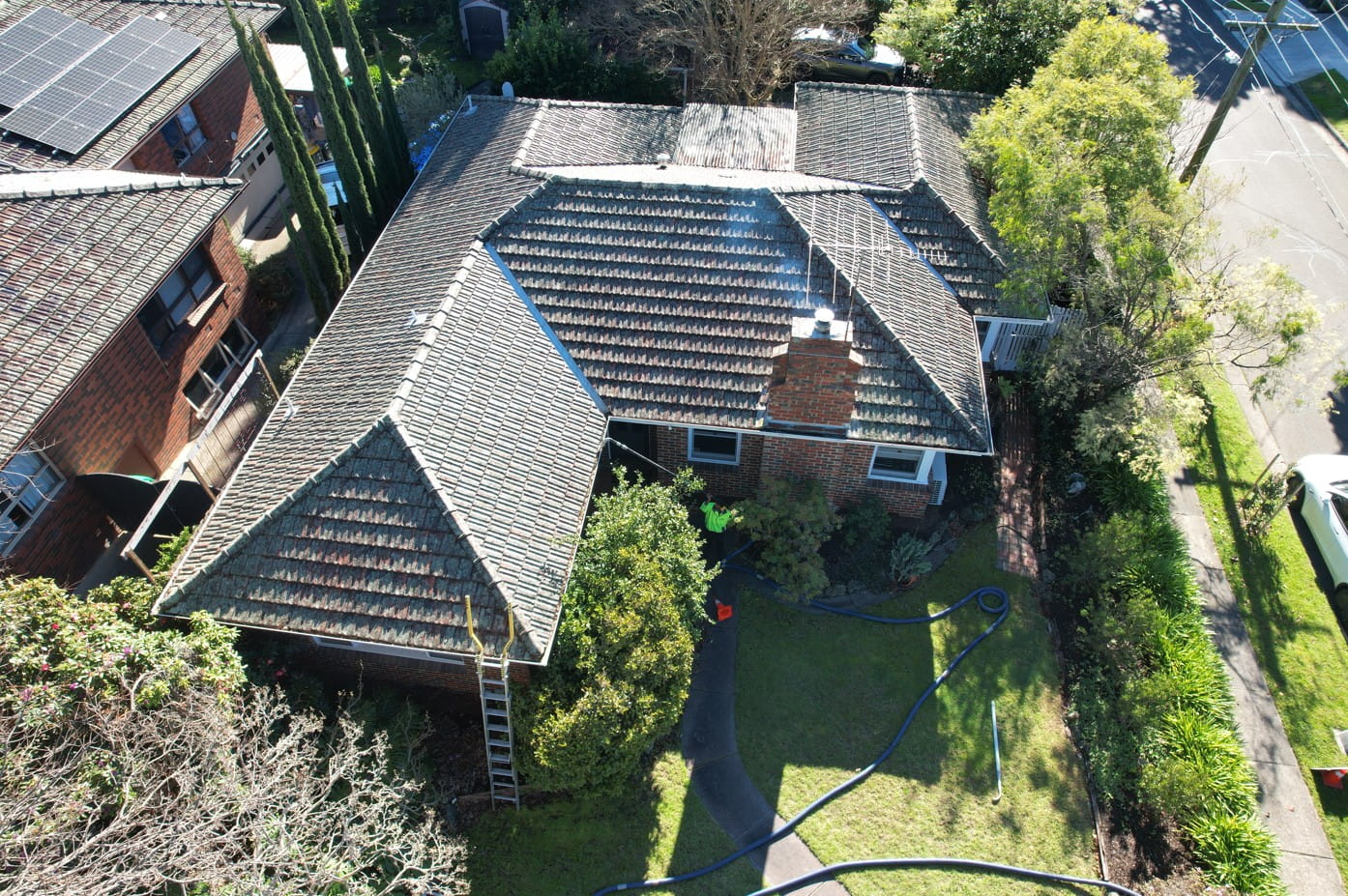
This property is the kind you find on hundreds of Melbourne streets. Wide road, deep nature strip, mature trees along both sides of the street. Single storey red brick, tiled roof, chimney, a TV antenna still up top. The trees that matter to this job are the ones on the right hand boundary, and we will come back to them.
“It’s an older house. Maybe 1950s or 1960s. A lovely little property.” Kev, PorterVac technician
Then there is what was actually growing on this roof.
What does moss on a roof actually tell you?
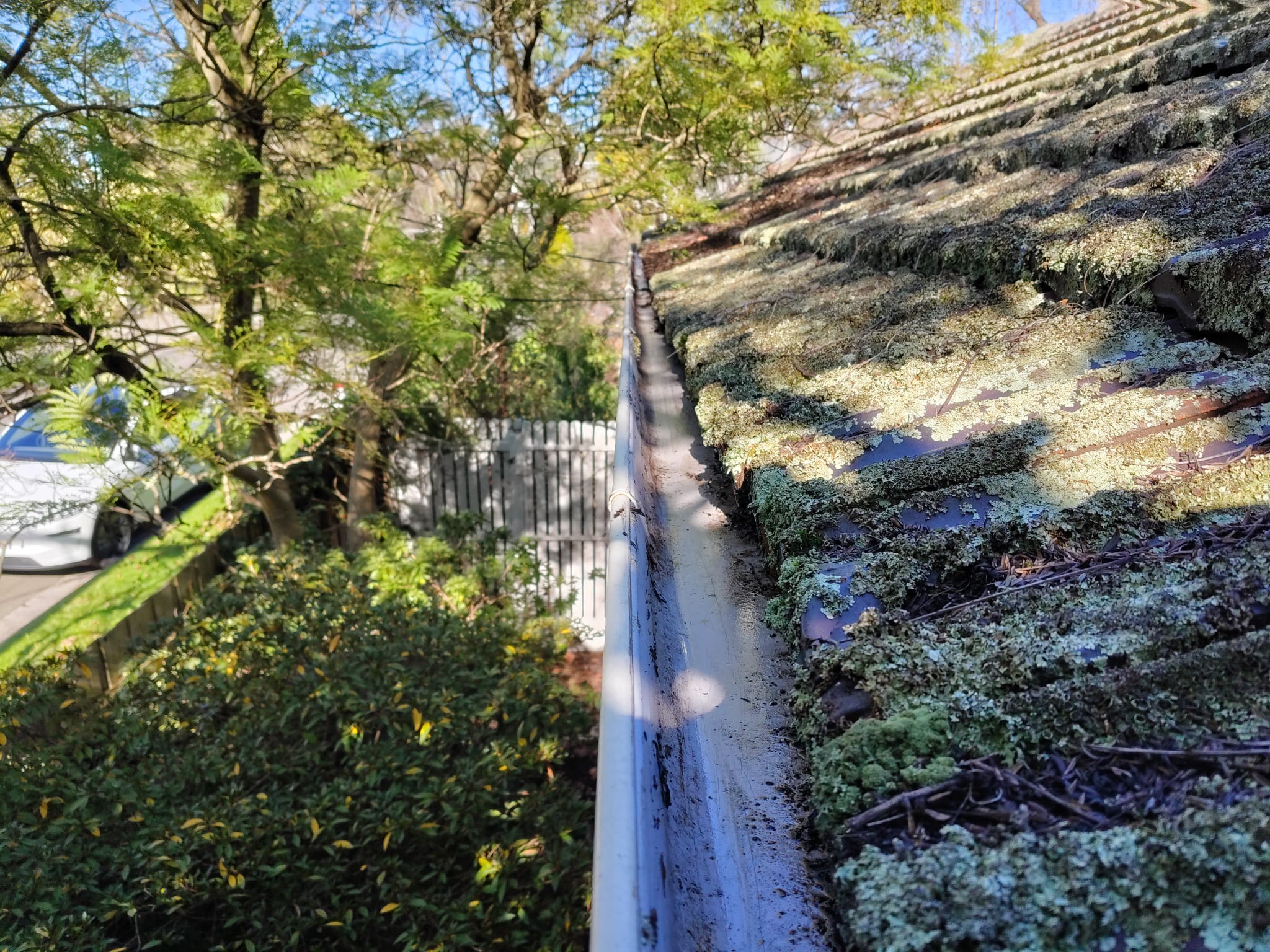
“There’s moss growing everywhere.” Kev
Look along the gutter line in the photo above. The tiles aren’t discoloured, they’re colonised, pale green and white across the whole exposed face. That is a mature growth, not a season of it.
Most homeowners read moss as a cosmetic problem. It isn’t, and it is not primarily a roof problem either. It is a traction problem.
Moss and lichen hold water. A tile surface carrying that much growth stays damp for hours after the rest of the roof has dried, and it stays slippery in conditions where a bare tile would be perfectly safe to walk. Melbourne in July makes that worse rather than better. Bureau of Meteorology long term averages for Melbourne record nine rain days in July and 9.3 in August, and August is the wettest month of the year by that measure. Here is the part most gutter cleaning advice gets backwards: winter is not when Melbourne’s biggest rainfall totals land, because April, October and November all beat it on volume. Winter is when it rains most often. Frequent rain rather than heavy rain is what keeps a shaded, moss-covered section of roof from ever getting a dry day.
There is a second thing worth knowing, and it’s the reason moss deserves attention beyond the safety question. Moss holds moisture directly against the tile surface and works its root structure into the pores of the concrete. Over years that accelerates the breakdown of the tile face, which is the same process that puts grit in your gutters. Where growth is heavy enough to be doing that, it’s worth dealing with on its own terms through roof pressure cleaning rather than waiting for the gutter clean to come around again.
So: a roof with a heavy moss load in the middle of a Melbourne winter is a roof you have a good reason not to walk. The owner asked. The roof agreed.
How does gutter cleaning from the ground work, step by step?
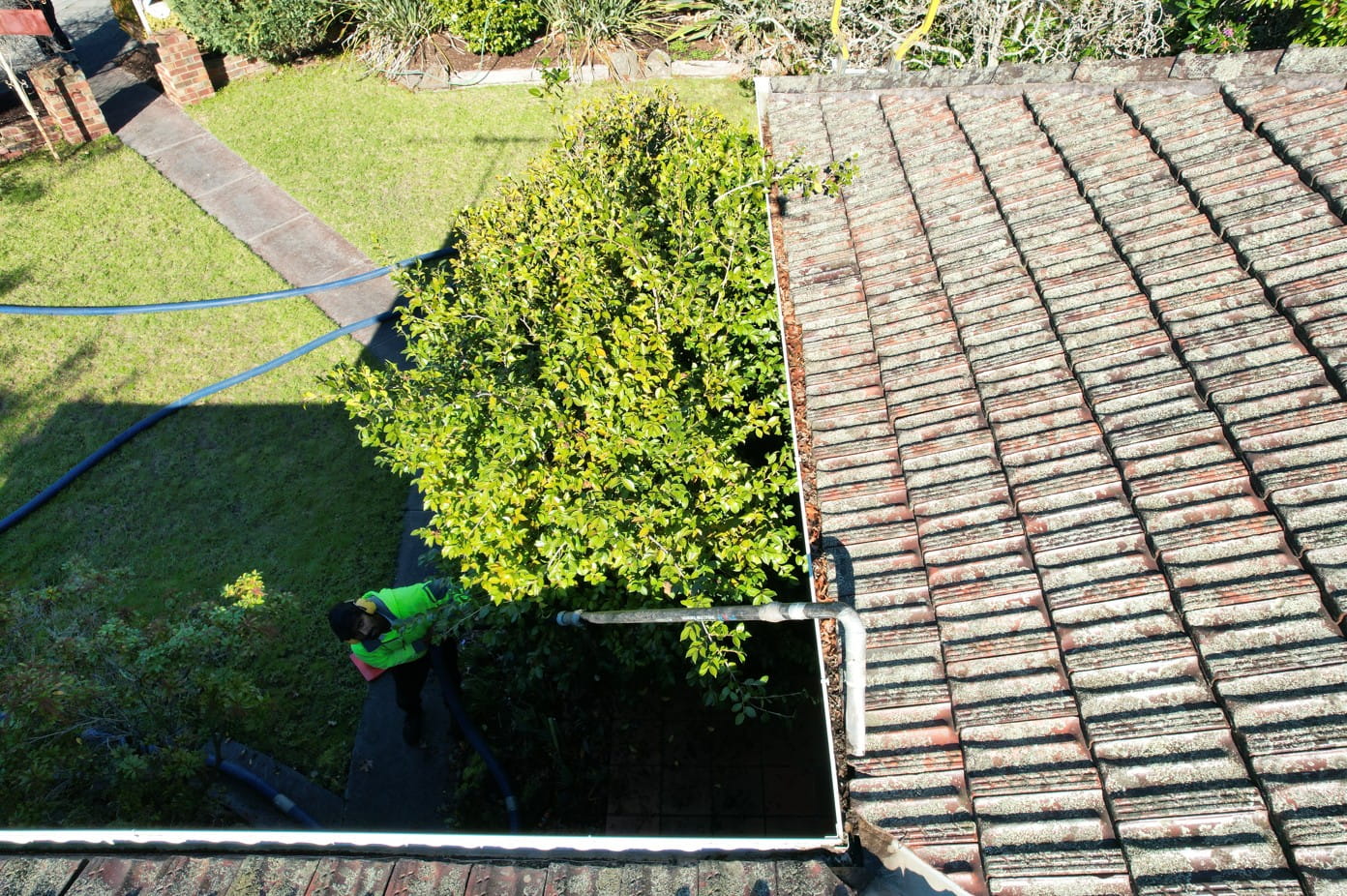
The order matters, and most of the job happens before any debris moves.
- Knock on the door. Someone in the house knows we have arrived and what is about to happen above their ceiling.
- Set up the safety zone. Cones and a workers above sign at the kerb, the truck positioned so the hose reaches, the ladder set and footed. You can see the whole setup in the first photo.
- Assess each run from the ladder. This is the part that replaces walking the roof. The technician goes up far enough to see into the gutter, photograph the condition, and work out where the load is heaviest and where the outlets sit.
- Extend the pole and clear the straight runs. The hose runs from the truck mounted vacuum unit up the pole to the gutter line, drawing leaves, twigs, grit and wet sludge straight into the sealed tank.
- Move the ladder and repeat. On this house that meant repositioning several times to work around the full perimeter.
- Clear the downpipe entries and the valley. The outlets are the point of the exercise. A gutter that looks clear from below and still will not drain has solved nothing.
- Photograph everything again and write the report. Before and after photos on every job, plus the roof condition report valued at $297, included at no charge.
Step three is where people get the wrong idea about this method. It’s not blind. The technician still gets eyes on every metre of gutter. What they don’t do is put their weight on a wet, moss-covered 60 year old tile.
Why does gutter cleaning from the ground take longer?
“This house is maybe 1.5 hours. It’s a small house, but doing the ground pole is the reason. Setting up the ladder, moving it, taking the photos, we need more time.” Kav
An hour and a half, on a small house, on a job that would have moved faster from the roof.
The extra time in gutter cleaning from the ground is entirely setup and repositioning. From the roof, a technician walks the perimeter once with the hose. From the ground, the ladder gets set, footed, climbed, worked from, climbed down and moved, run by run, all the way around the house. On a house with an awkward footprint or dense garden beds up against the walls, it takes longer again.
That’s worth saying plainly rather than presenting the ground level option as free. It’s not free. It costs time, it’s included in the same quoted price, and on the right property it is unambiguously the correct trade.
When is cleaning from the ground the right choice?
Not always, and it would be dishonest to pretend otherwise. Gutter cleaning from the ground is the better method on some roofs and the weaker one on others. Working from the roof gives a better clean on a complex roof and a far more complete condition report. Here is how we actually make the call.
| The property | What we recommend | Why |
|---|---|---|
| Heavy moss or lichen on the tiles, or any wet surface | Ground level | The traction is not there. This is the clearest case for the pole kit. |
| Brittle or chalky older concrete tiles | Ground level | Tiles that flex or crunch underfoot get walked once and then not again. |
| Steep pitch beyond safe walking angle | Ground level, or two technicians with a full anchor setup | Past a certain pitch, footwear and harness stop being the deciding factor. |
| No sound anchor point available | Ground level | No anchor, no roof access. There is no version of this we push through. |
| Owner simply prefers nobody on the roof | Ground level | It is your house. We do not need a better reason than that. |
| Sound, dry, walkable roof with complex valleys and multiple levels | From the roof | Better access to the valleys and a more complete condition report. |
| Very high, deeply set back or heavily obstructed gutter runs | From the roof | Beyond practical pole reach. |
That assessment happens on every job whether the customer raises it or not. The longer version of what we look at, and what a proper safety setup involves, is in our guide to what a gutter and roof safety audit covers.
How risky is it to clean your own gutters?
Riskier than almost anyone assumes, and the risk is not evenly spread.
There were more than 6,000 falls on and from ladders serious enough to put an Australian in a hospital in 2023 to 2024, according to Australian Institute of Health and Welfare figures reported by the ABC in January 2026. That is ladders alone, before roof falls are counted. At one Brisbane hospital, more than a third of the ladder and roof fall admissions across two years were people aged 65 and over. The injuries named by the trauma team were rib fractures, punctured lungs, and damage to the spleen and liver.
The Victorian numbers are the ones worth sitting with. The state government’s Better Health Channel records that 36 Australians died from falls from ladders in 2020, and 11 of them were Victorians. Victoria is about a quarter of the national population and carried close to a third of the deaths.
The activities behind those falls are not exotic. Window cleaning, trimming branches and clearing gutters.
There is also a principle in the professional standards worth borrowing. WorkSafe Victoria’s guidance for roofing work directs employers to use the highest level of fall prevention that is reasonably practicable, and to prefer platforms and access equipment over ladders wherever the work allows. The logic doesn’t stop at the boundary of a workplace. If the job can be done without anyone going up, that’s the version to do.
This is the part homeowners consistently get backwards.
A blocked gutter has never hurt anybody. Getting to it is what does.
What did our roof condition report find?
Two things, and they were on the same side of the house.
The debris load itself was unremarkable. Asked whether it was bad, Kev’s read was that it sat about average for a house of this age with this much canopy around it. That’s a useful benchmark: average does not mean fine, it means typical, and typical in a leafy Melbourne street is a gutter that is already failing to drain properly in places.
The right hand side was the exception.
“That side was blocked. The valley was blocked, and the downpipes on that side were blocked too.” Kev
A blocked valley and a blocked downpipe on the same elevation is a complete drainage failure on that section of roof. Not a slow gutter. Nowhere for the water to go. In heavy rain that water leaves over the front lip of the gutter, or it backs up under the tiles into the roof cavity, which is how clogged gutters cause water damage that people later assume must have come from a leak.
The roof itself gave a mixed reading. The valleys had been replaced at some point, which is a good sign and tells you a previous owner or trade took the roof seriously.
“They’ve had new valleys put in.” Kev
Everything else appeared to be original to the house, though that is a read from the gutter line rather than a confirmed history.
Maintenance history like that is worth knowing before you spend anything. A roof with new valley iron and original everything else is not a roof that needs a full restoration quote. It is a roof that needs someone to tell you which parts are which, which is what the free roof condition report is for.
That report is not a document that gets emailed and forgotten either. Kev goes back to the customer after the clean, walks them through what he found, and flags anything that might need a repair so they can decide for themselves. Where something structural does turn up, our roof repair team handles it directly, so it is not a matter of chasing a second trade.
Why does one side of a house always block first?
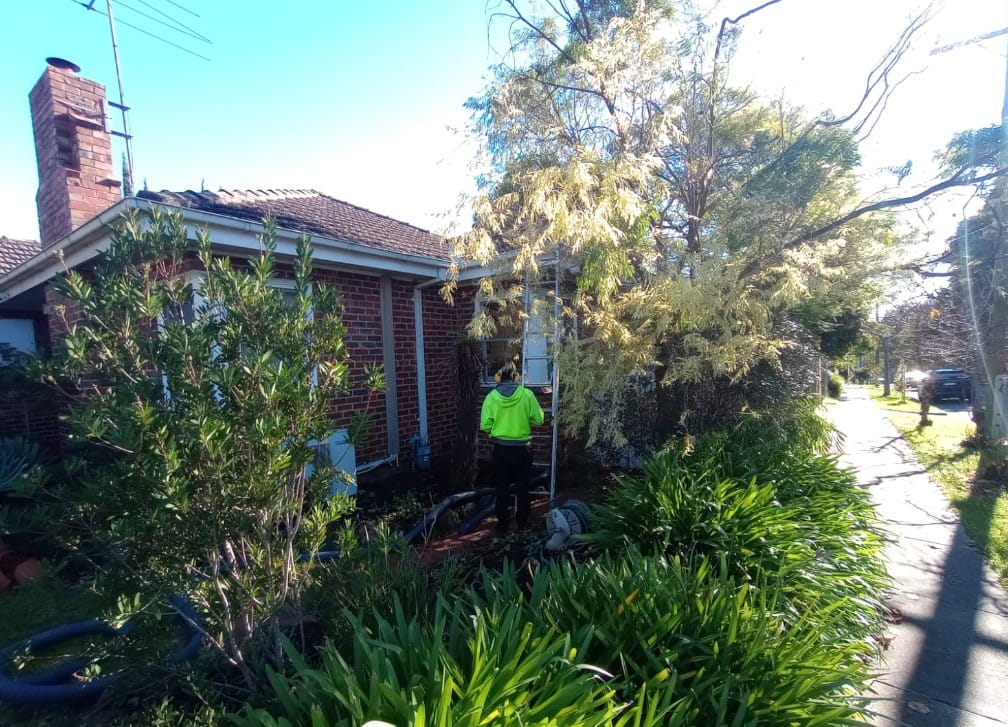
Because trees don’t distribute evenly, and neither does the drainage that has to cope with them.
“There’s a few trees on the right side of the house, about five metres tall or more, hanging right over the gutter. That side is always going to be a bit of a problem.” Kev
Five metres and directly over the gutter line is the worst geometry there is. It is not wind blown drop reaching the roof from a neighbour’s yard. It is material falling straight down into the run, concentrated on one elevation, all year.
Then the roof shape compounds it. Debris does not sit where it lands. Water moves it along the gutter until something stops it, and the things that stop it are corners, valley outlets and downpipe entries. So the failure is not distributed along the run either. It packs at the two or three points that actually do the work, which is exactly what happened here.
Which produces the effect that catches people out. A homeowner standing on the driveway looks up at a long straight length of gutter, sees something that looks acceptable, and concludes the gutters are fine. The straight runs are usually the last part to look bad. The outlets underneath went first. We have written the full version of that up in our guide to stopping downpipes blocking in the first place.
Kev’s advice to this owner had two parts, and the first one is the part people skip.
“Trim the trees back. And every year, you must clean the gutters.” Kev
Cutting the canopy back off the roofline reduces the load at the source. Worth checking your council’s rules first, because many Melbourne councils apply overlays that require a planning permit to remove or lop a protected tree, with maintenance pruning of dead branches generally exempt. Which species drop what, and when, is covered in our guide to which Victorian trees drop the most into gutters.
How often should gutters be cleaned when trees hang over one side?
Every twelve months, minimum. Kev was firm about that, and for a house with this much canopy near it, he’s right.
Our own view goes a step further, and the split below is ours rather than his. The complication on a house like this one is that the two sides do not need the same thing. One elevation sits under five metre canopy and the other is comparatively open, so a single annual clean is generous for one side and marginal for the other.
| What is over your roof | Recommended frequency | Why |
|---|---|---|
| Open block, minimal canopy | Every 12 months | Wind blown drop only, low volume |
| Mature trees on the block but clear of the roofline | Every 12 months, before winter | Moderate volume, mostly autumn |
| Trees overhanging one elevation (this job) | Every 12 months minimum, every 6 for that side | Direct drop concentrated on one run, plus shade holding moisture |
| Eucalypts over or beside the roof | Every 6 months, or every 4 for large gums | Year round shedding of leaves, bark and nuts |
| Pines or conifers near the roofline | Every 3 to 4 months | Needles pass through guard and seal downpipes early |
| Backing onto a reserve or creek corridor | Every 3 to 4 months | Mature native canopy on multiple sides, continuous drop |
The seasonal side of the question, meaning which months matter most and why, is covered in our guide on when and how often to clean your gutters.
What can you check without leaving the ground?
If the point of this article is that you do not need to be on the roof, it’s worth sharing which checks you can genuinely do from your own lawn. All of these are visible from the ground with no ladder involved.
- Watch the downpipes during heavy rain. A downpipe that stays silent while water sheets off the roof is blocked.
- Watch the front lip of the gutter in the same downpour. Water going over the edge rather than along to the outlet means the run is not draining.
- Look for green or white growth spreading across the shaded sections of tile, which means moisture is being held where it should not be.
- Look for plants or seedlings growing out of the gutter line. That is soil, and soil takes years to form.
- Look for rust streaks or staining on the fascia and on the wall below a gutter run.
- Look along the roofline for any visible sag or dip in a length of gutter.
- Check internal ceilings near the eaves after heavy rain for damp patches or shadowing.
None of that requires climbing anything. If any of it is present, that is the point to call someone rather than to go and have a look yourself.
Meet Kev: two years on the tools
Kev has been with PorterVac for about two years. Before Melbourne, he worked in construction in Sri Lanka, in a family business.
“I did the construction field. My father had a construction business and a hardware shop.” Kev
Which is a reasonable background for this work, and it shows in how he talks about the job.
“Normally gutter cleaning is very easy. Sometimes it’s hard, but normally it’s easy.” Kev
Coming from someone who has just spent ninety minutes moving a ladder around a house in the middle of winter, that is either understatement or a very good attitude. Probably both.
Book a gutter clean, on the roof or from the ground
If you would rather nobody walked on your roof, say so when you book. Gutter cleaning from the ground is a normal request, it does not cost extra, and on an older tile roof with moss on it we may well suggest it ourselves.
Single storey gutter cleaning starts at $320, and every job includes before and after photos of each gutter run plus the roof condition report valued at $297 at no charge. Full pricing is in our gutter cleaning price guide for 2026, and the equipment side is covered on our vacuum gutter cleaning service page.
We cover metropolitan Melbourne, with the full list on our areas we serve page.
Two ways to book:
- Call us on 1300 833 399 for a quote and a booking time
- Request a quote online and we will come back to you with a time that works
Frequently Asked Questions
Can gutters be cleaned without going on the roof?
Yes. A gutter vacuum pole kit reaches the gutter line from ground level, drawing debris down the pole into a sealed tank on the truck. Nobody walks the roof and no ladder leans on the guttering. It takes longer than working from the roof, because the ladder is repositioned run by run.
Does ground level gutter cleaning cost more?
No. It is quoted at the same rate as a standard clean, starting at $320 for a single storey home, even though it takes longer. Tell us when you book if you would prefer nobody on the roof, so we can allow the extra time in the schedule.
Is moss on my roof tiles a problem?
Yes, for two reasons. Moss holds moisture against the tile surface, which breaks down the face of the tile over time and puts grit in your gutters. It also makes the roof genuinely slippery for anyone walking it, long after the rest of the surface has dried.
How dangerous is cleaning your own gutters?
There were more than 6,000 ladder falls serious enough to require hospitalisation in Australia in 2023 to 2024, before roof falls are counted. In 2020, 36 Australians died from ladder falls, and 11 of those were Victorians. Clearing gutters is among the activities named behind those falls.
Why is only one side of my house blocked?
Because trees drop where they stand. An overhanging tree deposits material straight into the run beneath it rather than spreading it around the roof, so that elevation carries several times the load. Water then packs the debris at the corners, valleys and downpipe entries on that side.
What is a blocked roof valley?
A valley is the channel where two roof sections meet and shed water into the gutter. When it blocks, water backs up under the tiles rather than reaching the gutter at all. A blocked valley and a blocked downpipe on the same side is a complete drainage failure on that section of roof.
Can double storey gutters be cleaned from the ground?
Sometimes. Pole reach is finite, so a standard double storey front elevation is often workable while set back sections, high gables and anything obstructed by planting are not. We assess reach at the quote rather than on the day, so you know before you book which runs can be done this way.