

Last Updated on 9 September 2026
Our free roof condition report on a 40 year old tile roof in Heathmont found three things the gutters never showed: ridge capping past its service life, rust starting in the gutter runs, and cracked tiles at the corners. The gutters themselves rated a seven out of ten. That was the least important thing we found that day.
We’ve been cleaning gutters and inspecting roofs across Melbourne for more than 20 years, and every clean finishes with a roof condition report valued at $297, at no charge. Most of them come back saying nothing needs doing. This one didn’t, and it is the more useful kind of job to walk through.
Below is the whole visit, from the cones going out at the kerb to the recommendation the owner was left with, in the words of the technician who did it.
What does our roof condition report actually cover?
While the technician is on the roof, they inspect it properly. It adds about fifteen minutes to the job and it costs nothing.
The report covers:
- Cracked, slipped or broken tiles
- Ridge capping, bedding and mortar pointing
- Flashing around chimneys, skylights and vents
- The condition of the valleys
- Rust in the gutters and downpipes
- Any early signs of water entry into the roof cavity
- Pest activity and nesting
You get it in writing, with photographs, and there’s no obligation attached. That matters more than it sounds. A roof condition report is worth more when it finds nothing than when it finds something, because it tells you what not to spend money on this year.
The report is the quick version, done while we are up there anyway. The longer version, which looks at how the whole roof moves water off the building and where that system is failing, is set out in our guide to what a roof and gutter safety audit involves. This article is what one report actually turned up on one roof.
What does a 40 year old original roof look like from above?
Heathmont is one of 16 suburbs in the City of Maroondah, 25 kilometres east of the Melbourne CBD. It grew out of apple orchards into a residential suburb across the second half of last century, so the housing stock runs to single storey brick homes on generous blocks, planted out decades ago and now sitting under mature canopy.
This property is exactly that. Single storey, tiled roof, with an evaporative cooler and a TV antenna still up top.
“I think it’s about 30 or 40 years ago. Everything on the top is old quality.” Duong, PorterVac technician
The condition, in Duong’s words, was “not really bad”. The roof was original. No sign it had been restored, repointed or repaired at any point in four decades. On a house that age that is not a criticism of the owner so much as a fact about time. Everything up there wears out, and it does it quietly, above eye level, where nobody looks.
What did the gutters look like?
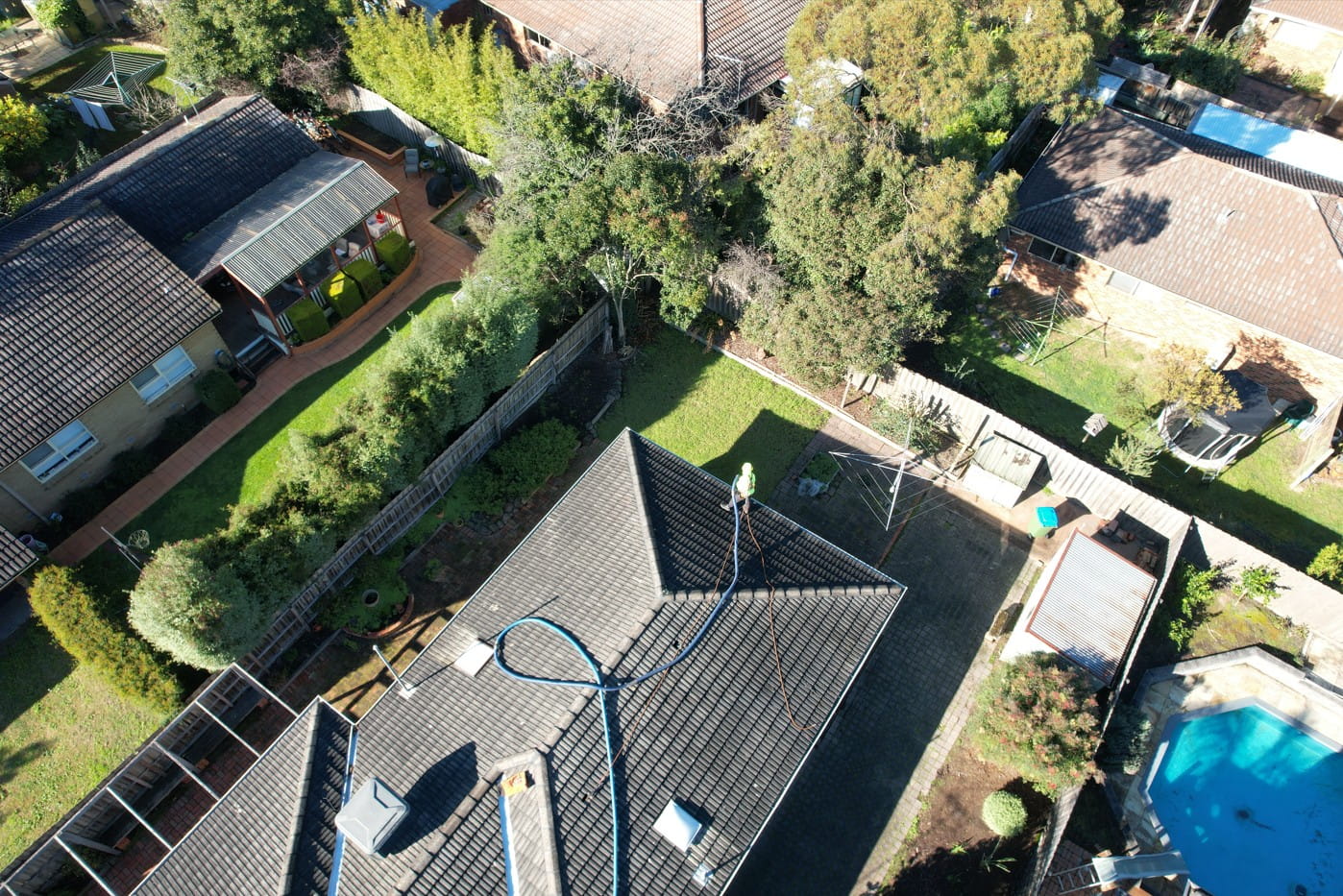
Leaves and sticks, across the front and both the left and right sides. Not the compacted black sludge you get when a gutter has been ignored for three or four years, and not a light scatter either. A genuine load, with enough woody material in it that a straight vacuum pass would not lift all of it.
Asked to rate it out of ten, Duong didn’t hesitate. Seven.
The timing is the part that matters. These photos were taken in early winter, so the gutters were carrying a full autumn’s drop and heading into the wettest stretch of Melbourne’s year with it. A seven in June behaves very differently to a seven in February. In summer, debris in a gutter is dry, light and a fire consideration. In June it’s saturated, heavy, sitting against the steel, and blocking the one system the house needs working.
The house had gone a while. Not dangerously long. Just long enough that the next month of rain would have been the one to find out.
What did our report find?
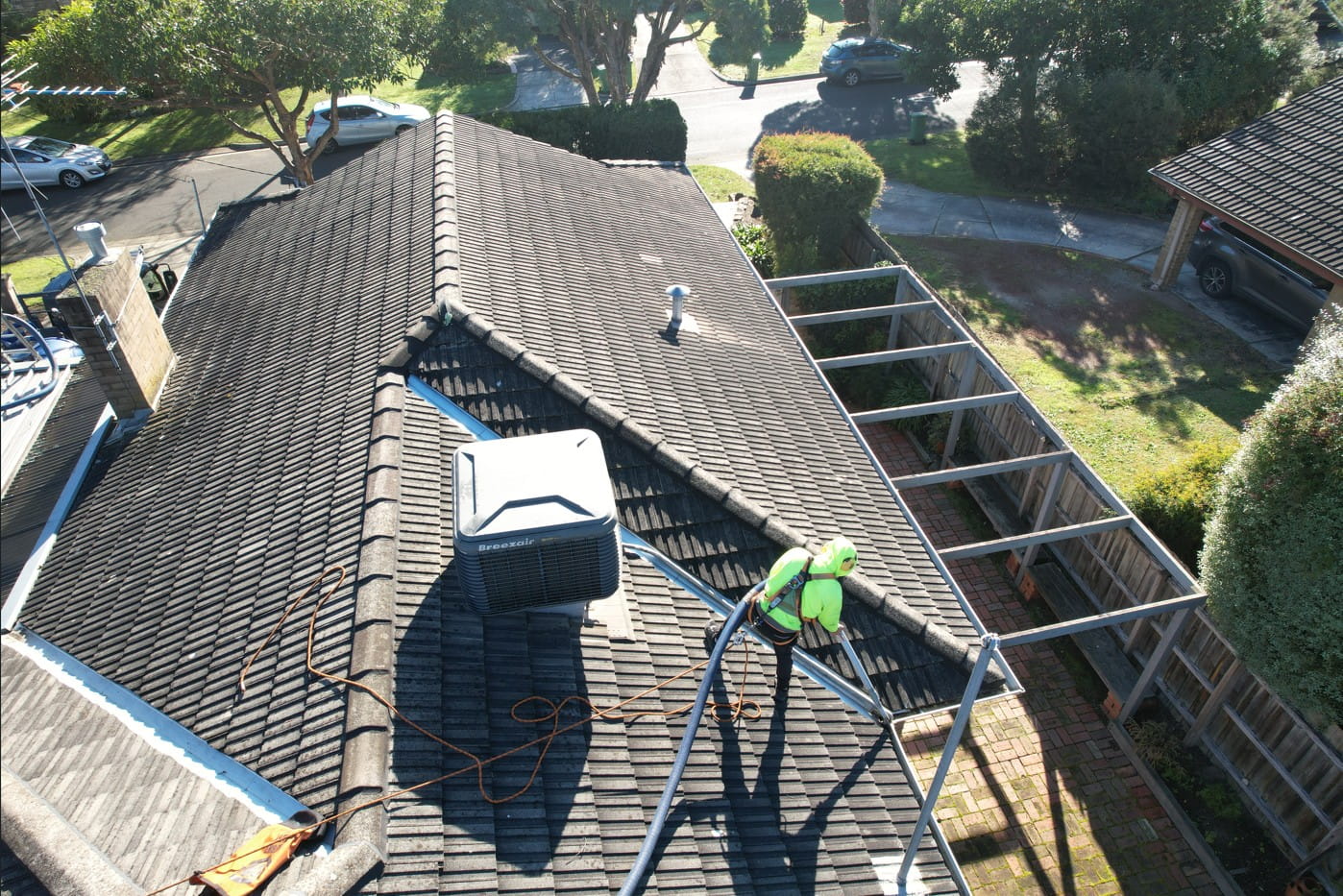
Three things, none of them visible from the footpath.
Ridge capping past its service life
The mortar along the ridge and hip lines was original and worn out, and Duong’s recommendation was renewal rather than a patch.
Rust starting in the gutters
Not through, but present, in the places you would expect. Rust starts wherever debris holds moisture against the steel for long enough, which is why it shows up in the corners and at the low end of a run first. It’s a slow failure with an obvious cause, and regular cleaning is most of the prevention.
Cracked tiles at the corners
A few, in the usual spots.
“Sometimes the tile is broken at the corner. Sometimes I fix it with silicone, or just recommend for the customer to renew it.” Duong
That judgment call is the useful part of the report. A hairline corner crack on an otherwise sound tile is a silicone job, done on the spot. Several cracks across a roof of the same age is a different conversation, because it usually means the tiles themselves have reached the end and patching them one at a time is money spent on a losing position. Knowing which of those you are looking at is worth more to a homeowner than the clean itself.
Where a report does turn up something structural, our roof repair team handles it directly, so it isn’t a matter of chasing a second trade.
Why does ridge capping fail before the tiles do?
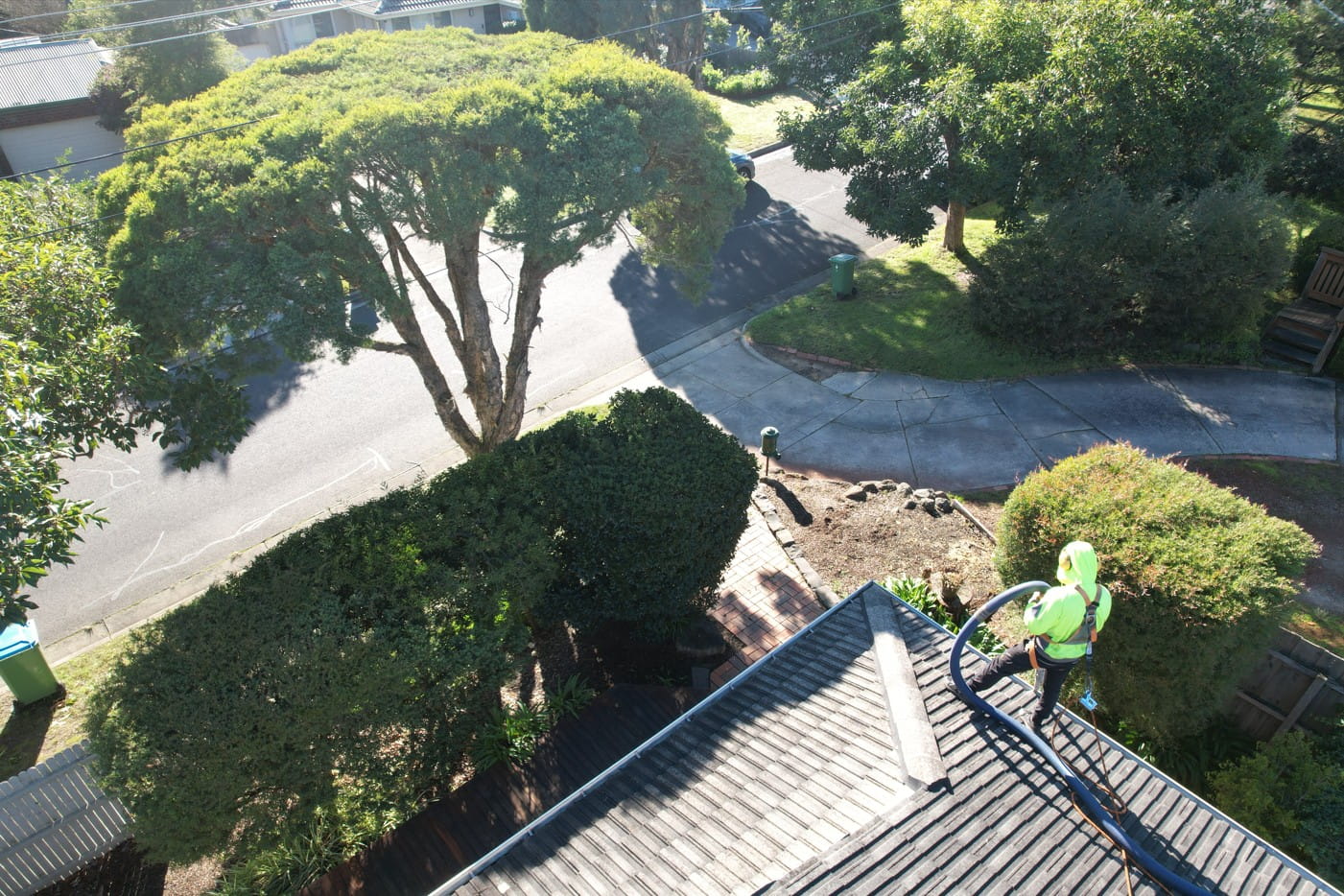
Ridge capping is the mortar bedding and pointing that holds and seals the capping tiles along the ridges and hips of a tile roof. It’s usually the first part of a tile roof to fail, and it fails without a single tile cracking or slipping.
The reason is simple. The capping sits at the most exposed line on the house, it expands and contracts through every hot day and cold night, and until 1995 the pointing used was cement mortar, which cracks rather than flexes. Flexible pointing compounds replaced it, and even those need redoing roughly every ten years. A roof still carrying its original 1980s cement is a long way past that.
Once the pointing cracks, water gets under the capping and into the roof cavity, and the tiles below can look perfect the whole time. It’s why “my roof looks fine” and “my roof is fine” are different statements. The full detail is in our guide to roof repointing and rebedding.
One early warning sign you can check without going up: grit or granules collecting in the gutter. That’s the mortar and the tile surface breaking down and washing off, and it usually shows up in the gutter well before anything shows up on the ceiling.
What happens when a roof is left too long?
Asked whether he had ever seen a property left long enough to cause real damage, Duong didn’t describe a gutter at all.
“One property, a big branch of the tree fell down and hit the roof. Ten broken tiles. The water coming in, and everything inside the house, in the ceilings. It was really, really bad.” Duong
That’s the version of roof failure that arrives in one afternoon rather than over five years, and it’s the one Melbourne homeowners consistently underestimate. VICSES responds to around 20,000 storm related requests for assistance a year, roughly 80 per cent of everything the service is called to, with storms costing Victorians about $28 million annually. Falling branches and dislodged roof tiles are named among the most common causes.
The connection to gutters is direct. The storm that drops a branch on your roof is the same storm delivering the heaviest rain of the year. Broken tiles plus a gutter that cannot drain is how water reaches a ceiling in a single night, and it’s why clogged gutters cause water damage that people assume must have come from a leak.
Which trees cause the worst jobs?
Duong’s answer was immediate, and it matches what we see across Melbourne’s east.
“The gum tree and the pine tree. Every house under those trees is really full.” Duong
Gums shed year round rather than in one autumn burst, dropping leaves, bark strips, twigs and nuts, so a house under eucalypts never gets the quiet six months a deciduous tree gives you. Pines are worse in a different way. Pine needles are small enough to pass through most gutter guard, fine enough to pack into a dense mat, and shaped perfectly to bridge across a downpipe opening and seal it while the gutter above still looks passable.
This is not a small factor in Maroondah. The council’s own vegetation strategy puts tree canopy cover across the municipality at 29%, with a further 18.9% shrub cover, and notes that vegetation on private land provides a large proportion of it. That canopy is most of what makes the area worth living in, and it’s also what lands in the gutters.
Worth knowing before you reach for a chainsaw: you may not be free to remove the tree. Maroondah requires a planning permit to remove trees covered by a Significant Landscape Overlay, which applies at a trunk circumference over 0.5 metres or a height over five metres, along with native vegetation under a Vegetation Protection Overlay. Council publishes the current thresholds and exemptions, and maintenance pruning of dead branches is generally exempt.
So for a lot of properties, the tree stays. Managing what it drops is the part you control. Our guide to Victorian trees that leave the most gutter clutter breaks down which species drop what, and when.
How do we clean a roof like this one?
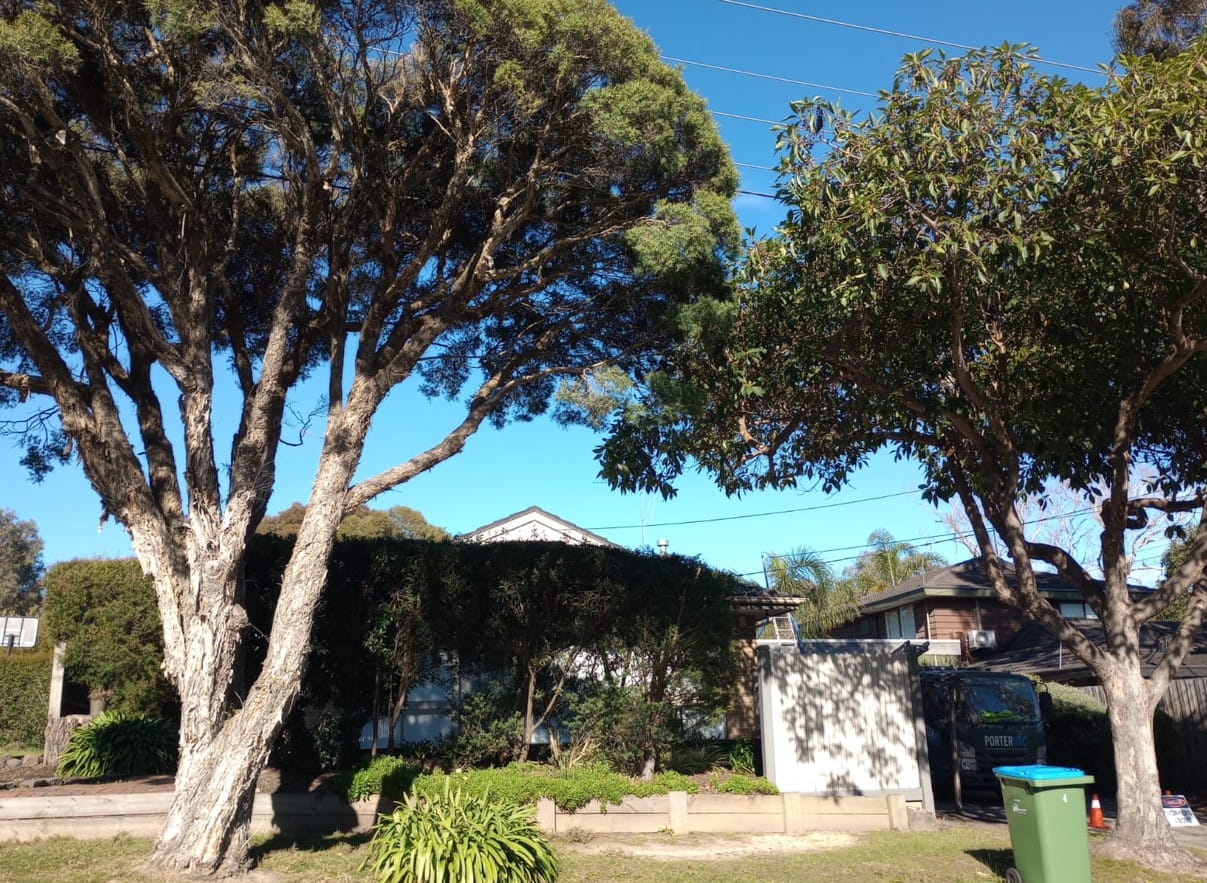
The order never changes, and most of it happens before anyone touches a gutter.
- Knock on the door. Someone in the house knows we have arrived and what is about to happen above their ceiling. It costs a minute and prevents every awkward version of this job.
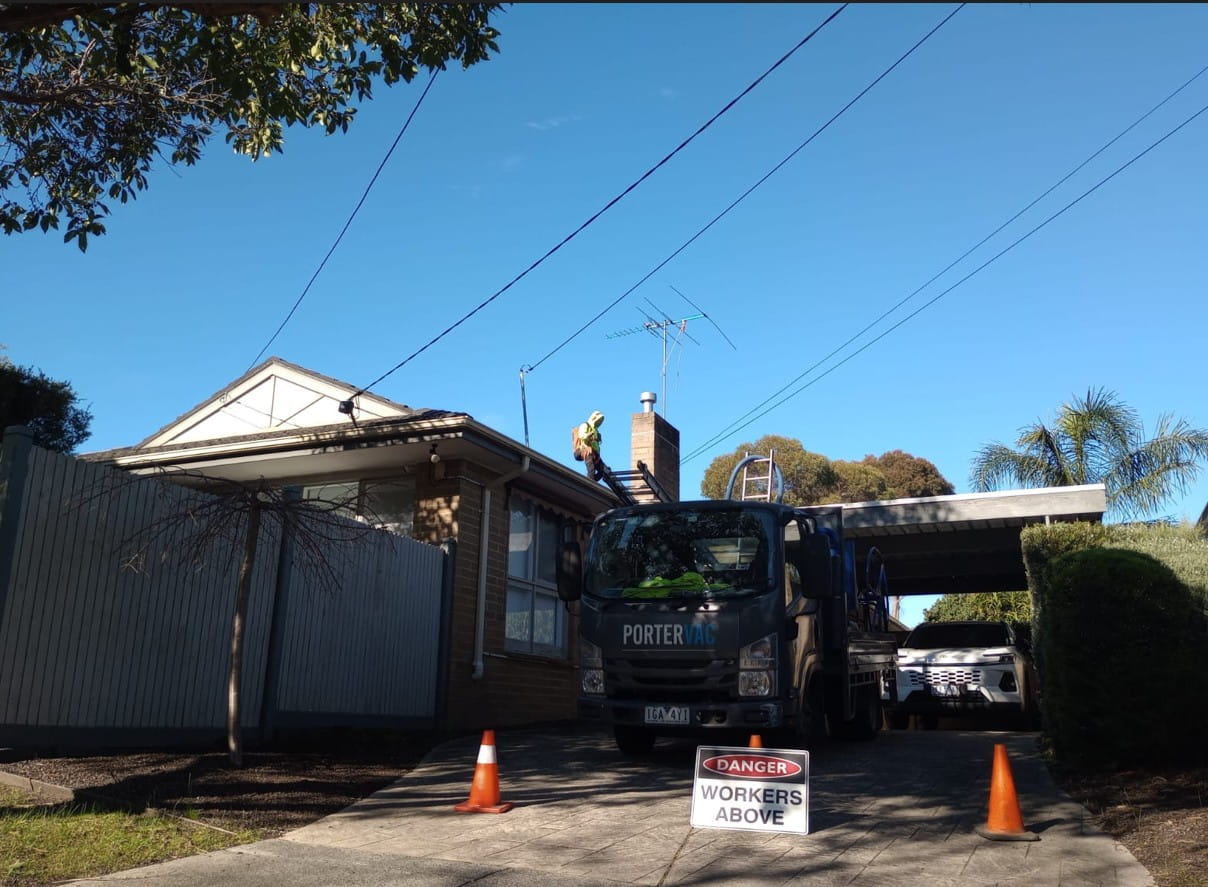
- Set up the safety zone. Cones and a workers above sign at the kerb, the truck positioned for hose access, the ladder set and footed. You can see the whole setup in the photo. It exists because things fall off roofs.
- Access the roof and tie off. Harness on, anchor points established before any walking.
- Clear the downpipe openings. The outlets get opened first, so everything that follows has somewhere to go.
- Vacuum the runs. A long flexible hose runs from the truck-mounted vacuum unit at street level up to the roof, letting the technician walk the gutter line while attached, drawing leaf matter, sticks and grit straight into a sealed tank on the truck. Nothing lands in the garden beds and nothing washes into the stormwater.
- Inspect, photograph, report. Before and after photos on every job, plus the roof condition report.
More on how the vacuum method compares to a ladder and a bucket is on our vacuum gutter cleaning service page, with the technical detail in our breakdown of gutter vacuuming methods.
How do we decide whether a roof is safe to walk?
Before anyone steps off the ladder, the technician makes a judgment call about the roof itself. On a 40 year old tile roof, that call matters more than it does on a five year old one, because age changes how the surface behaves underfoot.
Four things get assessed, in this order:
- Surface condition. Wet tiles are out, full stop. So is any roof carrying moss or lichen on a shaded section, which stays slippery long after the rest has dried. On this Heathmont job the weather was warm and dry, so the roof was safe to work.
- Pitch. Past a certain steepness a roof stops being walkable regardless of footwear or harness, and the job changes method rather than getting attempted anyway.
- Tile brittleness. Older concrete tiles get chalky and lose strength. A technician can feel the difference through a boot within a few steps, and a roof that flexes or crunches does not get walked further.
- Anchor points. There has to be somewhere sound to tie off. No sound anchor, no roof access.
When any of those fail, the answer is not to press on carefully.
“Just let the customer know, try to rebook it, and get two guys or whatever to make sure they’re safe before getting on the roof next time.” Duong
The job gets rescheduled and re-crewed rather than pushed through by one person having a go. There’s also a middle option that solves a lot of these properties: a ground pole kit lets us clear gutters from ground level without anyone going up at all. It’s slower and doesn’t suit every roof, but on a brittle or steep roof it’s the difference between the job getting done safely and not getting done.
This is the part homeowners underestimate. The roof is the risk, not the gutter. A blocked gutter has never hurt anybody. Getting to it is what does, which is why the assessment above happens on every job whether the customer asks for it or not, and why a full gutter and roof safety audit is worth reading before anyone decides to handle their own.
How often should gutters be cleaned?
Duong’s read on this property was twelve months, and that’s the right call for it. Trees around the block, none of them directly over the roofline.
“Over here the gutters should be cleaned every twelve months. If the house has a big tree, or trees around it, it should be cleaned more.” Duong
The variable is not how leafy your street looks. It’s what sits directly above your roof, and what species it is.
| What is over your roof | Recommended frequency | Why |
|---|---|---|
| Trees on the block but clear of the roofline (this Heathmont job) | Every 12 months, before winter | Wind blown drop only, moderate volume, mostly in autumn |
| Deciduous trees overhanging part of the roof | Every 6 months | Heavy seasonal drop straight into the gutter line |
| Eucalypts over or beside the roof | Every 6 months, or every 4 for large gums | Year round shedding of leaves, bark and nuts, no quiet season |
| Pines or conifers anywhere near the roofline | Every 3 to 4 months | Needles pass through guard, mat densely, and seal downpipes early |
| Backing onto a reserve or creek corridor | Every 3 to 4 months | Mature native canopy on multiple sides, continuous drop |
For the seasonal side of the question, which months matter most and why, see our guide on when and how often to clean your gutters.
What are the warning signs an old roof needs attention?
This owner had no obvious symptoms, which is the norm. A roof fails quietly and then all at once. These are the signals you can check from the ground:
- Grit or granules collecting in the gutter, which usually means the pointing or the tile surface above is breaking down
- Loose, lifted or missing capping tiles along the ridge and hip lines
- Visible cracking in the mortar when you look along the ridge line from the yard
- Rust streaks or staining on the fascia or the wall below a gutter run
- Damp patches or shadowing on internal ceilings near the eaves after heavy rain
- Moss or lichen spreading across a shaded section of roof, which means moisture is being held where it shouldn’t be
Any one of those and it’s worth getting someone up there to look properly.
Meet Duong: two years on the tools
Duong has been with PorterVac for close to two years, after hands-on work with a company overseas before moving to Melbourne. We asked what he likes about the job, the answer was not about roofs either.
“It’s the freedom. Working outside, going far away. It’s like travelling.” Duong
Which is a fair description of the work. Every day is a different suburb, a different roof, and a couple of hours standing on someone’s house forming a view about it.
Book a clean and get your roof condition report
If your roof is original, there are mature trees anywhere on the block, and nobody has been up there in a few years, the report is the part worth booking for. The gutter clean is what gets someone onto the roof to do it.
Single storey gutter cleaning starts at $320, and the roof condition report valued at $297 is included at no charge, along with before and after photos of every gutter run. Full pricing is in our 2026 gutter cleaning cost guide.
We cover Heathmont and the wider City of Maroondah, including Ringwood, Ringwood East, Croydon, Bayswater, Vermont and Mitcham, along with the rest of metropolitan Melbourne.
Two ways to book:
- Call us on 1300 833 399 for a quote and a booking time
- Request a quote online and we will come back to you with a time that works
Frequently Asked Questions
What is a roof condition report?
A roof condition report is a written inspection of your roof carried out while our technician is already up there for the gutter clean. It covers tiles, ridge capping, flashing, valleys, rust and signs of water entry, and comes with photographs. It is valued at $297 and included free with every clean.
How do I know if my ridge capping needs redoing?
Look for loose or missing capping tiles, visible cracking along the ridge line, and grit or granules turning up in your gutters. Pointing generally needs redoing about every ten years. Homes built before 1995 still carry cement mortar, which cracks rather than flexes, so they are usually first in line.
Do I need to fix a cracked roof tile straight away?
It depends how many. A single hairline crack on an otherwise sound tile is a silicone repair and can be done on the spot. Several cracks of the same age across a roof usually means the tiles are at the end of their life, and patching them one by one stops being worth the money.
Why are pine needles worse than leaves in a gutter?
Pine needles pass through most gutter guard, pack into a dense mat that water struggles to move through, and bridge across a downpipe opening to seal it. A gutter under pines can look reasonably clear along the straight runs while the outlets underneath are already blocked solid.
How often should gutters be cleaned in Melbourne?
Twelve months is the baseline for a home with trees on the block but nothing directly over the roofline. Drop to every six months if a tree overhangs the roof, and every three to four months for pines, large gums, or blocks backing onto a reserve or creek corridor.
What if my roof is too steep or fragile to walk on?
We do not push through it. The job is rescheduled with a second technician, or we clear the gutters from ground level with a pole kit so nobody goes up. Brittle tiles, steep pitch, wet surfaces and no sound anchor points are all reasons a technician will call a stop.
Do I need to be home for the clean?
No. We need access to the property and a spot at the kerb for the truck. The before and after photos and the roof condition report are emailed afterwards and payment is by invoice, so plenty of our Maroondah customers are at work while we are there.