Last Updated on 9 September 2026
A commercial solar array is one of the larger capital investments on a business rooftop, and it only pays back if the panels keep working at capacity. The problem is that soiling happens slowly and quietly. Dust, pollen, bird droppings, and grime build up a little at a time, output drifts down, and unless someone is watching the monitoring data, the loss goes unnoticed until the quarterly bill creeps up.
For Melbourne businesses, the local conditions add up fast: summer pollen and bushfire ash, salt carry in bayside suburbs, industrial dust around the west and north, and heavy bird activity on large flat commercial roofs. We have been cleaning and maintaining commercial roofs across Melbourne since 2003, and dirty panels are one of the most common and most overlooked causes of underperformance we see.
This guide covers what actually matters for a commercial site: how much soiling really costs you, how often a commercial array should be cleaned, what the job costs, the safety and compliance realities of working on a commercial roof, and how to prove the payback with your own monitoring data.
Do commercial solar panels really need cleaning?
Yes, and the reason is money, not appearance. According to the International Energy Agency’s PV Power Systems programme, soiling causes a 3 to 5 per cent loss of annual energy production worldwide, and after available sunlight, it is the single biggest factor affecting how much a solar system actually generates. In dustier conditions the losses run much higher. Australian industry testing has reported that even a thin layer of dust can cut output by up to 30 per cent in arid and high-dust settings.
On a small home system a few per cent is a modest number. On a commercial array of 100 panels or more, a few per cent is a large amount of lost generation across a year, and it compounds every quarter the panels go uncleaned. Bird droppings make it worse than general dust, because a single dropping can fully shade a cell and create a hot spot, which over time can permanently damage the panel rather than just reduce output.
There is a warranty angle too, which we cover further down. The short version is that letting panels sit dirty is not a neutral choice. It costs energy generation now (and increasing grid-energy bills) and can cost you a warranty claim later.
Our commercial solar panel cleaning service
How often should you clean a commercial solar array in Melbourne?
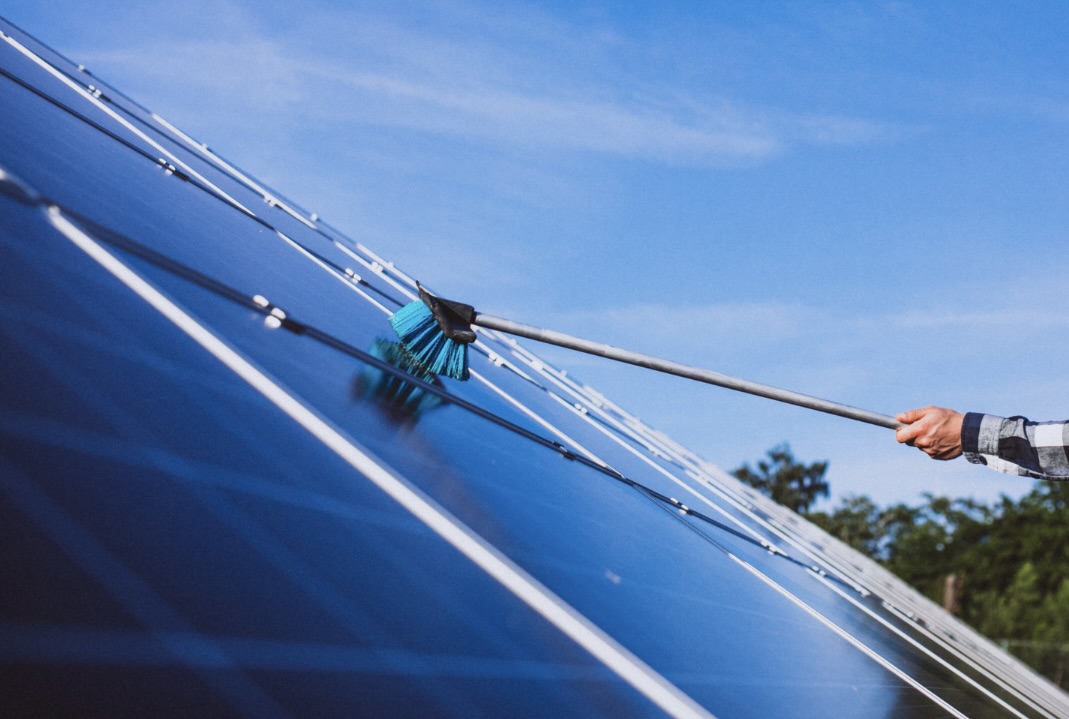
There is no single answer, because it depends on what is landing on your roof. As a baseline, most commercial arrays in Melbourne should be cleaned once or twice a year, but the right frequency depends on the surroundings.
The table below is the guide we work from.
What about Low-pitched Commercial Roofs?
A low-pitched commercial roof also matters, because panels closer to flat do not shed dust in the rain the way steeper residential roofs do. Flatter arrays hold water and dust in the lower edge of each panel, so they usually need cleaning more often than a homeowner would expect.
How much does commercial solar panel cleaning cost?
We usually quote commercial cleaning per site rather than off a fixed price list (as is typical in our industry), because the cost is driven by the size of the array, roof height and access, how much safety equipment the job needs, and how heavily soiled the panels are.
As a rough guide, per-panel rates in Victoria typically sit around $10 to $15 a panel, with larger jobs attracting a lower per-panel rate.
These are indicative market figures for Melbourne. The real number depends on your roof.
The more useful way to think about cost on a commercial site is against the generation you recover: if a clean restores several per cent of output across a large array for a full year, the cleaning often pays for itself well before the next service is due.
DIY, a general contractor, or a qualified specialist?
For a home system, careful ground-level cleaning can be possible. For a commercial building, it rarely is, because the roof is higher, the array is bigger, and the safety obligations are different. Here is how the three options compare for a commercial site.
The pattern is straightforward. On a commercial roof, the safety exposure and the value of the asset both point to a trained specialist rather than a hose and a ladder.
Safety and compliance on a commercial roof
This is where commercial cleaning genuinely differs from a home job. Work on a commercial roof is working at heights, which in Victoria carries real obligations. WorkSafe Victoria sets out the duties around fall prevention, and a fall from a commercial roof is exactly the kind of incident those rules exist to prevent.
For a building owner or facility manager, sending an untrained person or an uninsured operator onto the roof is a liability you do not need. A qualified cleaning specialist brings the right access equipment, a safe work method for the site, and insurance that covers roof work. We do not publish step-by-step roof access instructions for this reason. The safe and compliant path on a commercial building is a trained, insured operator, not a member of staff sent up with a bucket.
How commercial cleaning is done without disrupting operations
A common worry is downtime. In practice, a commercial array does not need to be switched off during cleaning, so the panels keep generating and your operations are not interrupted.
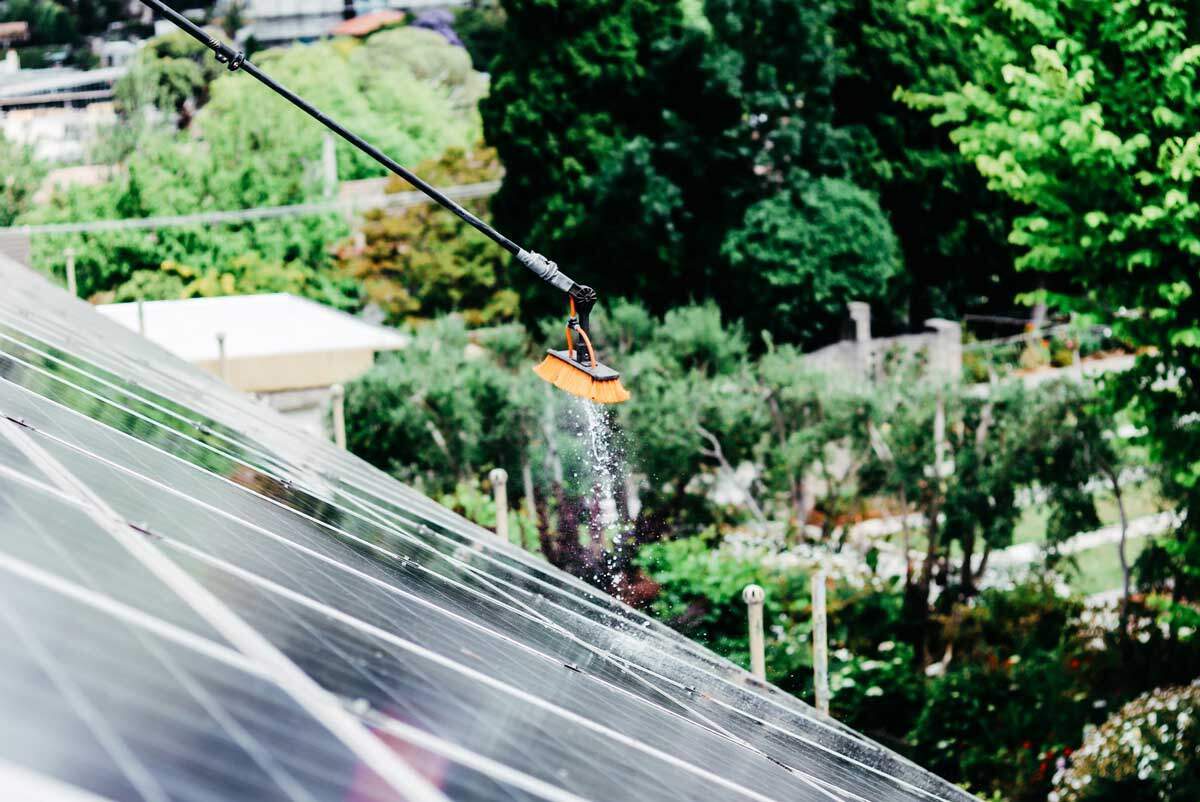
The method matters as much as the timing. We clean with deionised (purified) water, which lifts grime and dries without leaving the mineral spotting that ordinary tap water leaves behind. Soft brushes and fed pole systems do the work, and we never use pressure washers or harsh chemicals, both of which can damage panel seals and coatings. Where the middle of a hot Melbourne summer day is unavoidable, cleaning is timed for the cooler parts of the day to avoid thermal shock on hot glass.
Our process on a commercial site runs in four steps:
- Assessment. We check the array and roof condition and flag anything that needs attention.
- Preparation. We set up safe access and confirm the site is ready.
- Cleaning. Panels are cleaned with deionised water and safe equipment, with no interruption to generation.
- Post-clean inspection and report. You receive before and after photos and a free roof report, so you can see the condition of both the panels and the roof.
Cleaning and your solar warranty
Most commercial panel warranties assume the array is maintained, and many are explicit that damage caused by incorrect cleaning is not covered. Pressure washing, abrasive pads, and harsh chemicals are the usual culprits. Using a qualified solar panel cleaning specialist who follows manufacturer-safe methods protects the warranty and gives you a documented maintenance record, which is exactly what you want on hand if you ever need to make a claim.
Proving the payback: watch your monitoring data
The advantage of a commercial array is that you can measure the result. Note your inverter or monitoring output before the clean and again after, ideally comparing similar weather, and the uplift is usually visible straight away. Over a large array, recovered generation is what turns cleaning from a cost into a return.
The best results come from scheduled maintenance rather than waiting for a visible problem. A planned clean once or twice a year keeps the performance ratio high, avoids the slow drift most sites never notice, and lets you budget the cost as a known line rather than a surprise. For multi-site operators and owners corporations, a scheduled program across every roof is the simplest way to keep the whole portfolio performing.
Why gutter and roof maintenance matters for commercial buildings

The bottom line
Dirty panels are a slow, quiet drain on a commercial solar investment, and on a large array even a few per cent of lost output adds up across a year. The fix is simple: a scheduled clean once or twice a year, done safely with the right equipment, measured against your own monitoring data so you can see the return.
PorterVac cleans and maintains commercial solar arrays across Melbourne and surrounding suburbs, using deionised water systems and trained, insured operators, with a free roof report on every job. With hundreds of Melbourne businesses and homeowners reviewing our work on Google, you can see how we approach a site before you book.
Contact PorterVac today to arrange a clean or a scheduled maintenance program for your commercial array.
Frequently asked questions
Do commercial solar panels need to be turned off during cleaning?
No. The panels keep generating during the clean, so your operations are not interrupted. There is no need to shut anything down for the cleaning itself.
What water is used to clean commercial solar panels?
Deionised, or purified, water. It has the minerals removed, so it lifts grime and dries clean without the spotting that tap water leaves behind. That matters on a large array where hand drying every panel is not practical.
Can you pressure wash solar panels?
No. High pressure can force water past the seals and damage the panel, and it can void the warranty. Professional cleaning uses low pressure, soft brushes, and purified water instead.
How often should a Melbourne commercial site clean its panels?
Once a year is the baseline for a standard rooftop. Sites near trees, the coast, industrial areas, or with heavy bird activity should move to twice a year or more. The table above sets out the common cases.
Is DIY cleaning worth it for a business?
Rarely. On a commercial roof, the height, the size of the array, and the safety obligations make DIY a poor trade. The risk and the chance of damaging panels usually outweigh the savings.
Do you provide a report after the clean?
Yes. Every commercial clean includes before and after photos and a free roof report, so you have a record of the work and any roof issues we spot along the way.